Refactoring a Monolith with Google Antigravity
Last night I took Google Antigravity for a serious spin on a real problem: refactoring a large, monolithic Java class that had slowly accumulated far too many responsibilities.
Instead of experimenting on a toy example, I pointed Antigravity at an actual production-style codebase and let it operate as a development assistant rather than a code generator. The results were surprisingly solid.
The Starting Point: A Monolithic Class
The original class had grown into a classic “god object”:
- Multiple responsibilities bundled together
- Tight coupling between unrelated concerns
- Hard-to-test logic mixed with IO and formatting
- Increasing friction every time a small change was needed
Manually refactoring this would normally involve:
- Identifying logical boundaries
- Extracting classes carefully
- Updating call sites
- Running and testing repeatedly to ensure nothing broke
This is exactly the kind of task that’s tedious for humans but ideal for a capable automation tool.
What Antigravity Did Well
Using Antigravity’s development workflow, the tool:
- Decomposed the monolith into smaller, focused subclasses
- Preserved existing behavior while improving structure
- Rewired method calls cleanly between the new components
- Updated supporting helper and configuration classes
- Ran the web application after refactoring to validate behavior
The most impressive part wasn’t just the decomposition—it was that Antigravity verified the refactor by actually running the app and confirming everything still worked.
That feedback loop matters.
Real Refactoring, Not Just Code Shuffling
What stood out is that this wasn’t a naive “extract class” pass. Antigravity showed awareness of:
- Responsibility boundaries
- Naming conventions
- Dependency direction
- Maintainability concerns
The end result looked like something a careful developer would produce after an hour or two of focused work—not a rough first draft.
Development Experience
Here’s a snapshot of Antigravity in action during the refactor:
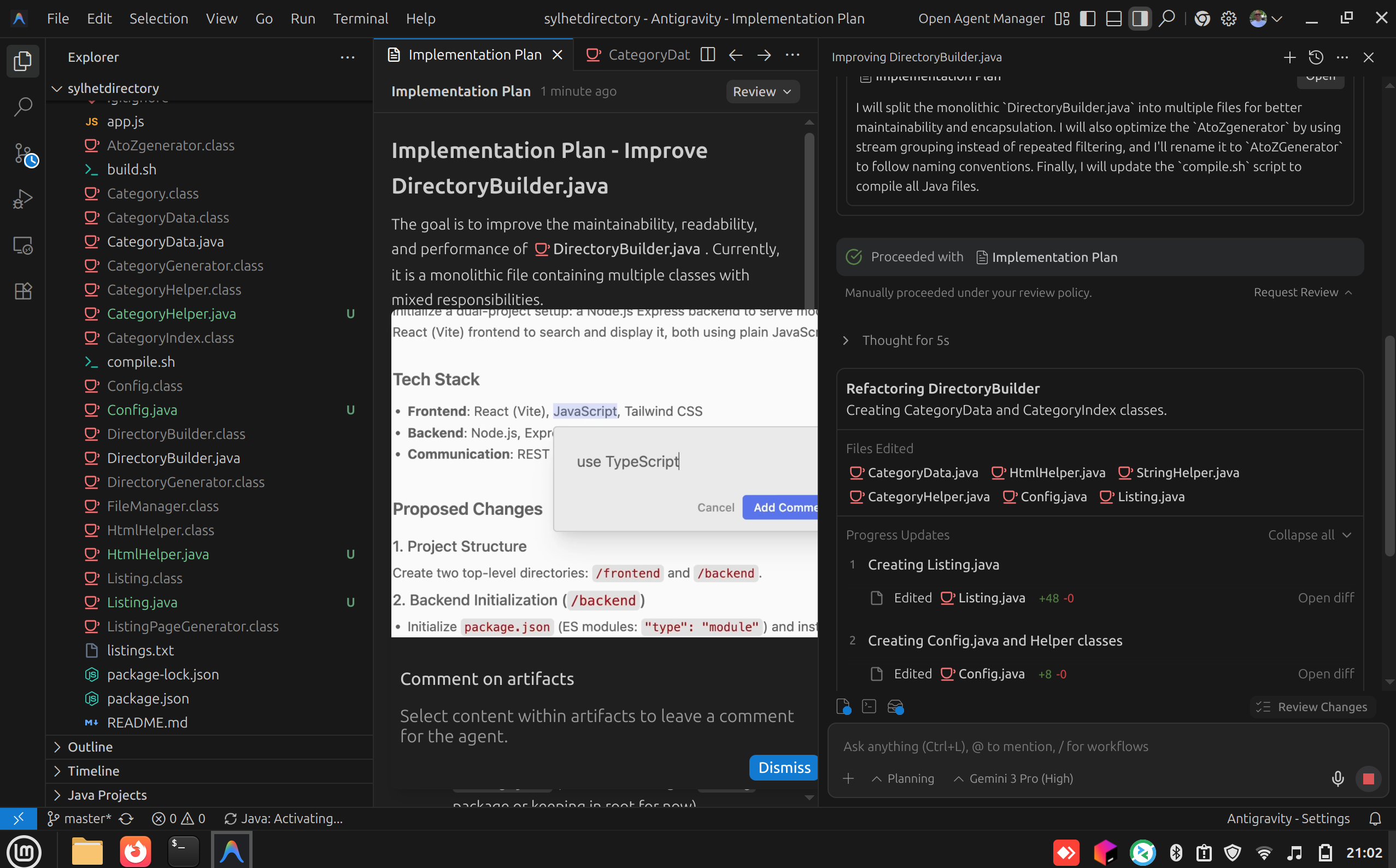
The interface made it easy to:
- Review the implementation plan
- Track which files were edited
- See progress updates for each refactoring step
- Manually review and approve changes as they happened
This kept me firmly in control while still offloading the mechanical work.
Takeaways
After one evening of real use, a few conclusions stood out:
- Antigravity is strongest when used on existing, non-trivial code
- It excels at structural refactoring, not just generation
- Verification via running the app is a huge confidence booster
- This feels like a genuine productivity multiplier, not a gimmick
I wouldn’t blindly accept every change in a critical system—but as a refactoring partner that does the heavy lifting, Antigravity is already useful today.
If this is the direction developer tools are heading, refactoring legacy code might finally become less painful—and maybe even enjoyable.
Next up: trying Antigravity on a test-heavy codebase and seeing how it handles behavior-driven changes.