 Software Architect
ahoque.ali@ahoque.org
Software Architect
ahoque.ali@ahoque.org
The Surma River Talks: Where Ideas Meet the Current
There is a stretch along the Surma River in Sylhet where the water moves slow enough to carry a conversation across. Picture this: a modest stage, perhaps just a raised wooden platform under the canopy of old trees, with the river behind it and an open sky above. A leading figure — a scientist, a poet, an economist, a technologist — steps forward and gives a short, focused talk. Fifteen minutes. No PowerPoint deck spanning forty slides. Just a human being, an idea, and the quiet insistence of flowing water.
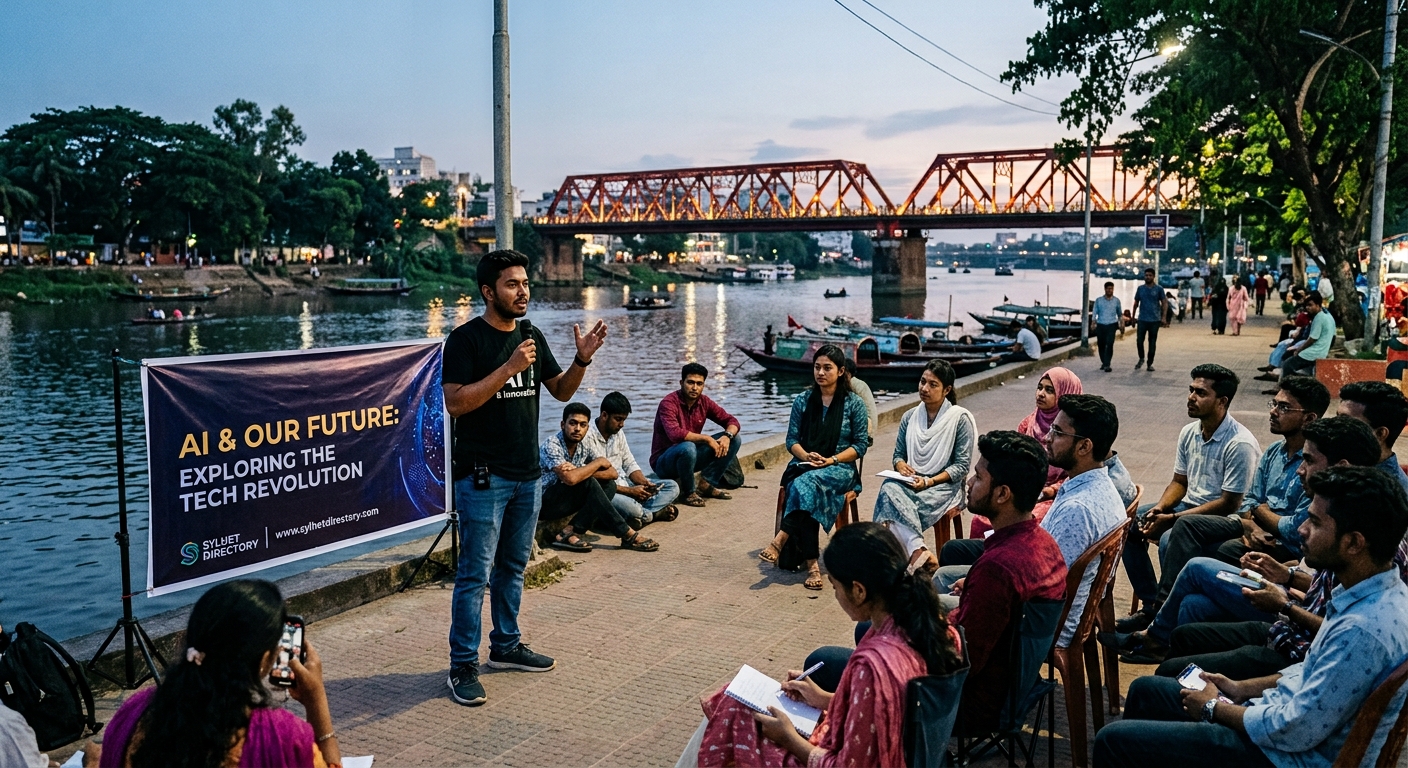
This is what I imagine when I think about what Sylhet deserves.
Why the Surma?
Every great city of ideas has its gathering place. Athens had the Stoa. London has its debating societies. Silicon Valley has its conference halls. Sylhet has something none of them do — the Surma River, a waterway that has carried trade, culture, and the Sylheti diaspora’s ambitions for centuries. The river is not merely a backdrop. It is an argument. It says: ideas here are not abstract. They flow. They reach the sea. They connect places.
A talk given by the Surma is a talk given with the weight of geography behind it. The audience — students from Shahjalal University, local professionals, wandering minds who happened to hear about it — sits on the grass, on the steps leading down to the water. No velvet ropes. No registration fees. The barrier between speaker and listener dissolves the same way the riverbank dissolves into the river.
Why Short?
The constraint is the point. Fifteen to twenty minutes forces clarity. It eliminates the performative jargon that creeps into hour-long keynotes. The best ideas do not need a full afternoon. They need conviction and economy. The format mirrors the river itself — relentless, forward-moving, not lingering where it is not needed.
Think of the compounding effect. A physicist explains dark matter in twenty minutes to a room of Sylheti university students. A novelist reads a passage and talks about memory for fifteen minutes. A policy maker lays out a vision for the haor region in eighteen minutes. Each talk is a seed. The brevity means people actually attend, actually listen, actually carry the idea home along the river road.
Why December?
December in Sylhet is gentle. The monsoon has passed. The air is cool. The tea gardens are green and approachable. The diaspora is home for the holidays — Sylhetis who work in London, Toronto, Dubai, and Sydney return in December carrying the perspectives of a dozen different systems. These are precisely the people who should be speaking, and precisely the audiences who should be listening.
An annual December gathering — The Surma River Talks — becomes a ritual. Rituals create expectation. Expectation creates preparation. Preparation creates quality. Within three years, the question shifts from “Will this happen again?” to “Who is speaking this December?”
What It Could Become
Year one: five speakers, two hundred listeners, a borrowed stage. Year two: local sponsors, a small festival of ideas alongside the existing cultural calendar. Year three: speakers begin to plan their December around it. By year five, the Surma River Talks are what people mention when they describe Sylhet — not just a city of tea and green hills, but a city that thinks out loud.
The river does not stop. Neither should the conversation.